Guide · General
Reputation Management Cost: Software Prices in 2026
Reputation management cost for review software starts near $19 a month. See what drives the quote and how to compare plans side by side.
By the TopToolAdvisor research desk · Updated November 17, 2026 · 12 min read

Review monitoring software starts at $19 per month on ReputeMap's published pricing for one to 200 locations, managed review services start at $125 per month for a single location, and reputation campaigns start at $3,000 per month. Those are three different jobs at three different orders of magnitude, and the gap between them is where most reputation management cost comparisons go wrong.
The fee is small next to what it protects. A 2023 Aon report built on 340 reputation-related events between 1982 and 2022 found that affected companies took an average 7% hit to shareholder value in the year after an event, which across the full sample came to roughly $830 billion in shareholder-value loss beyond normal market movement (Aon Reputation Risk Analytics 2023). A company valued at $1 billion that loses 7% is a $70 million problem, and that lands before any revenue disruption or higher insurance costs.
Historical work on reputation scores points to the same scale. A CIRANO review of the Fortune Most Admired Corporation research reported that a one-point decline in reputation was associated with an average market-value loss of about $5 billion when applied to the 50 largest US listed companies, and that moving a score from 5 to 8 was associated with a 1 percentage point reduction in the annual cost of equity and a 7% increase in firm value (CIRANO review of reputation research). What follows compares published prices line by line: what each plan includes, how it bills, and which figures still need a written quote.
Table of Contents
- Reputation Management Cost by Service Type
- What Moves the Monthly Quote and How Locations Multiply It
- How to Compare Two Quotes Side by Side
- Break-Even Math for a Monthly Reputation Budget
- When Managed Services and Campaigns Cost More
- Choose a Plan and Confirm the Price
Reputation Management Cost by Service Type
Review monitoring software runs from $19 to $189 per month on published plans, while managed review services start higher and full reputation campaigns sit in scoped, quoted territory rather than on a pricing page. The table below is the first lookup: one row per service type, with the vendor, the published starting price and the billing basis each figure is quoted on.
| Service type | Vendor | Published starting price | Billing basis |
|---|---|---|---|
| Review monitoring software | ReputeMap | $19 to $189 per month | Per company, one to 200 locations |
| Review software | GatherUp | $124 per month for one location, or $99 per month billed annually | Per location band |
| Managed review service | WebFX | From $125 per month for one location | Monthly retainer |
Read the billing basis column before the price column. ReputeMap prices per company across one to 200 locations, so a ten-site business pays the same entry rate as a single-site business, and the spread from $19 to $189 covers that entire range. A per-location quote works differently: every site added multiplies the fee, so two quotes that look close on the sticker can land far apart once locations are counted. GatherUp shows $124 per month for one location and $99 per month on annual billing, a lower monthly rate paid for with a twelve-month commitment.
ReputeMap's reputation management cost comparison lays these models side by side, including WebFX managed review services from $125 per month for one location, with that vendor's own pricing page identified as updated in February 2025. Campaign and audit work sits outside a table like this on purpose: strategy audits, editing retainers and reputation campaigns are scoped per project and quoted individually, so the honest answer on those is a written quote rather than a published number.
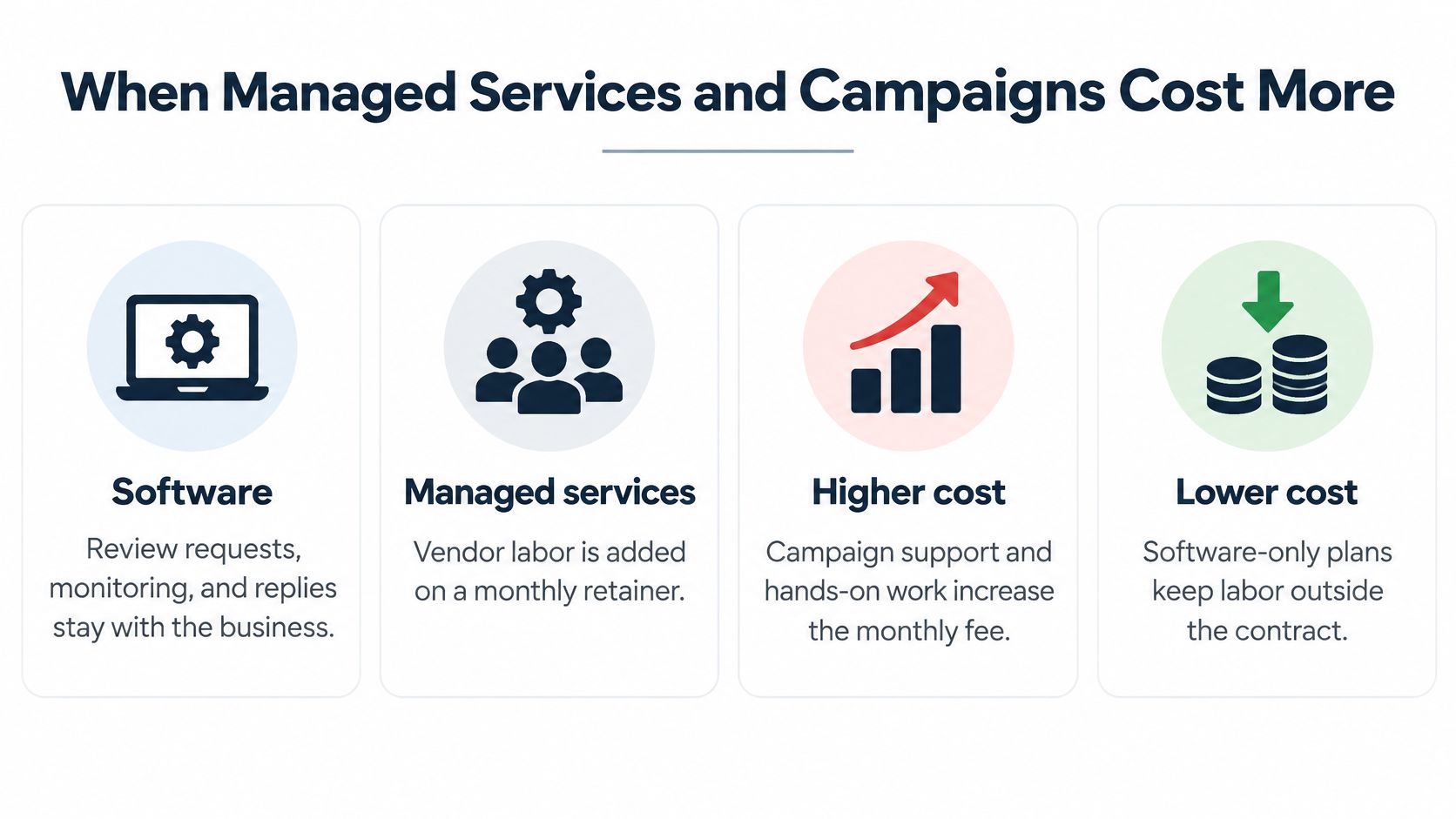
The operational split matters as much as the number. Software leaves review requests, monitoring and replies with the customer. A managed service adds vendor labor and typically bills a monthly retainer, so the fee buys hours rather than access. A business that needs help collecting feedback and routing it to the right manager should start with a comparison of customer feedback software rather than a retainer, because that is the cheaper adjacent category.
ReputeMap carries the lowest published starting price in the table, and GatherUp publishes an annual rate that lowers the monthly equivalent for buyers willing to commit. TopToolAdvisor warns that vendors update prices without notice and advises confirming each figure on the vendor's site before relying on it.
What Moves the Monthly Quote and How Locations Multiply It
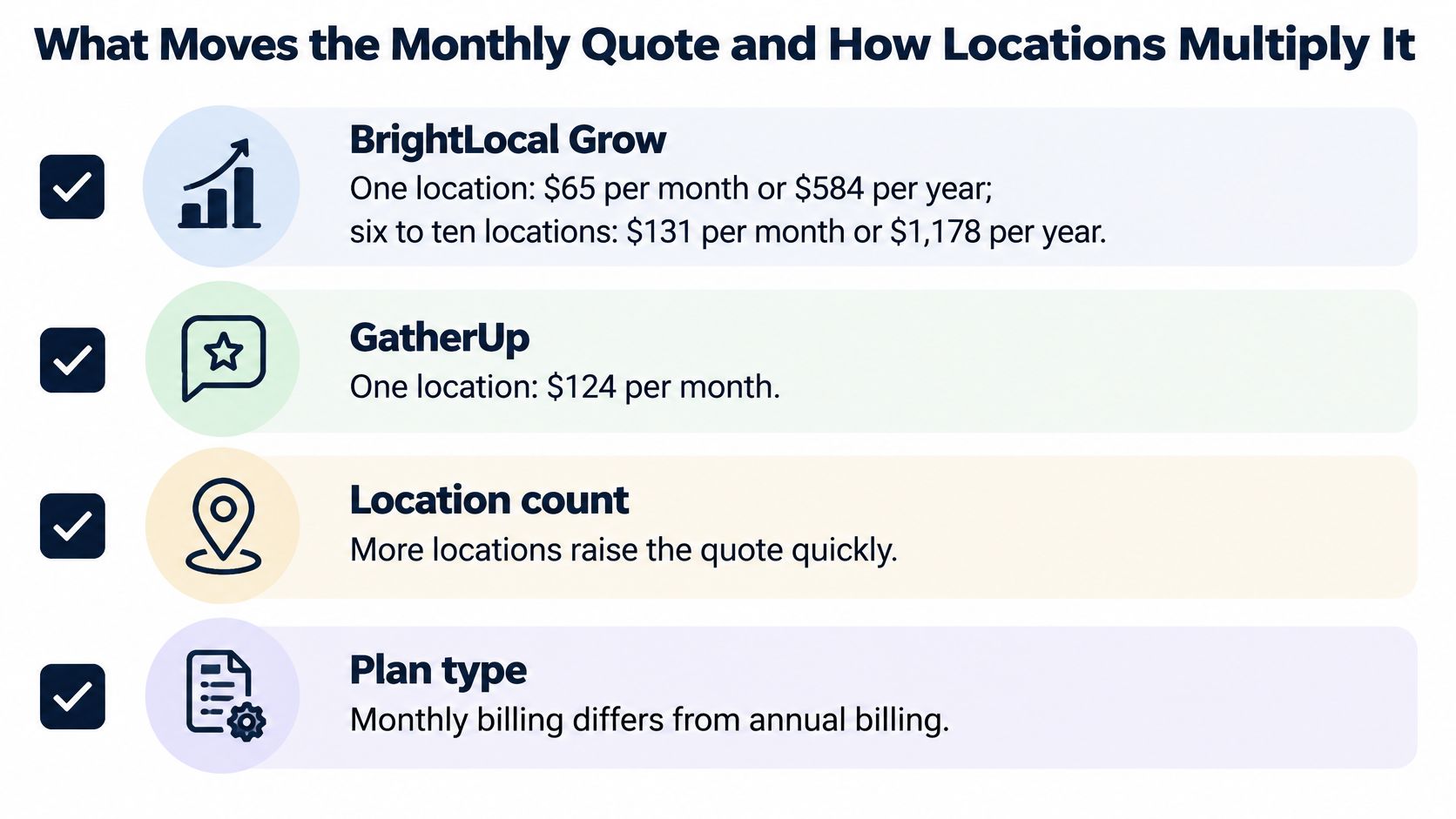
Location count moves a reputation bill further than any feature comparison. BrightLocal Grow is published at $65 per month or $584 per year for one location and $131 per month or $1,178 per year for six to ten, while GatherUp runs $124 per month for one location, $99 per month equivalent on annual billing, and $75 per location per month for two to ten locations, or $60 per location equivalent annually (Influencer Marketing Hub's review of reputation management software pricing).
| Vendor | Location band | Monthly price | Annual billing price |
|---|---|---|---|
| BrightLocal Grow | One location | $65 per month | $584 per year |
| BrightLocal Grow | Six to ten locations | $131 per month | $1,178 per year |
| GatherUp | One location | $124 per month | $99 per month equivalent |
| GatherUp | Two to ten locations | $75 per location per month | $60 per location per month equivalent |
| ReputeMap | One to 200 locations | $19 to $189 per month | Monthly only in the published comparison |
Annual billing is where the arithmetic gets interesting. BrightLocal Grow's $584 yearly rate works out to about $48.67 per month, roughly a quarter below the monthly price, and GatherUp's annual plan saves $25 per month on a single location, or $300 across a year. The saving is real, and it is paid for with a commitment that outlasts most vendor relationships.
Five Inputs That Change the Quote
- Location count. Most plans price per location or per location band, and BrightLocal Grow more than doubles between one site and six.
- Review request and SMS volume. Text credits are usually capped, and the pricing review notes that SMS credits may need separate confirmation.
- User seats. User allowances sit outside the headline figure, so a five-person marketing team needs the per-seat price before signing anything.
- Listings and integrations. Directory sync and CRM connections are listed separately in the same review, so a missing integration becomes either an add-on fee or manual work.
- Contract length and implementation. Annual terms lower the monthly rate and lock the account, while implementation charges land once, in year one.
The Multi-Site Effect
At GatherUp's two-to-ten band, two locations cost $150 per month and ten cost $750. The second site adds $26 over the single-site $124, and sites three through ten each add $75. A franchise comparing a $124 single-site quote against a $750 ten-site bill is looking at the same product, not an upgrade.
Published survey data backs the spread. A 2025 survey of more than 250 US marketing and sales professionals, reported in a pricing analysis of online reputation management cost, found that 72% of businesses spent between $100 and $10,000 per month, while 67% spent between $151 and $5,000 per location. The per-location figure is the useful half: it tells a multi-site buyer that the quoted monthly fee is a unit price, not an account total.
Where the problem is local visibility rather than review handling, the money belongs in a different category. Local SEO tools compared on published prices cover the overlap before anyone buys a review platform for the wrong job.
Order of operations: settle the location count first, then weigh the annual discount against usage limits and add-ons. Until the site count is fixed, the headline monthly fee answers the wrong question.
How to Compare Two Quotes Side by Side
Two quotes can match on the monthly line and land hundreds of dollars apart over twelve months. The difference sits in the billing unit, the usage caps and the contract terms, and a worksheet that captures each column makes the gap visible before signature day.
| Criterion | What to confirm | Effect on total cost |
|---|---|---|
| Pricing unit | Per company, per location or per user | Multiplies across sites and seats |
| Billing period | Monthly or annual, and the per-month equivalent | Annual billing lowers the monthly figure but locks the term |
| Usage limits | Review requests, SMS credits and reply volume | Overage fees can exceed the base plan |
| User seats | Included logins and the price of extra users | Adds cost as the team grows |
| Listings and integrations | Which directories and CRMs are included | Missing connections need add-ons or manual work |
| Setup fee | One-time onboarding or implementation charge | Adds cost in year one only |
| Contract length | Term, renewal and cancellation notice | Limits how quickly the buyer can switch |
| Price date | Date the vendor price was checked | Prices can change without notice |
Fill one column per vendor, then calculate the twelve-month total for the same number of locations and the same number of users. A quote of $124 per month for one location and a quote of $75 per location for a ten-site account are not comparable until both are multiplied out to the same footprint.
TopToolAdvisor product profiles carry a score, the vendor price as published and a short take on who the product suits, which gives a first pass on fit before the worksheet gets filled. The score doesn't replace twelve-month arithmetic, but it shortens the list to two or three vendors worth the calculation.
Setup Effort Is a Line Item Too
Ask how long onboarding takes, and whether the vendor connects the Google Business Profile and the review sites or whether staff do it. Ask who writes the review request templates and the reply rules for one and two star reviews. An account that needs twenty staff hours to configure in month one carries a cost that never appears on the pricing page, and a business that bills those hours to clients can price the difference exactly.
Record the date every figure was checked. A price with no date cannot be compared with a quote that may be weeks newer.
Where the gap hides: per-location pricing against per-company pricing, monthly against annual billing, and included usage against overage charges. Settle those three and the rest is detail.
Break-Even Math for a Monthly Reputation Budget
One division turns a monthly fee into a decision. Divide the fee by the gross profit on one extra customer, and the answer is how many additional customers the plan has to produce each month to pay for itself. Average sale multiplied by gross margin gives profit per customer. Fee divided by profit per customer gives customers needed.

Run it three ways and the picture changes fast.
- A dental or home-services practice. An average job of $150 at a 40% gross margin leaves $60 per job. A $124 monthly plan needs about 2.1 extra jobs, so three additional jobs a month cover the fee and leave change.
- A low-margin shop. An average order of $35 at 30% margin leaves $10.50. A $19 entry plan needs about 1.8 orders, so two extra orders clear it.
- A $500 managed plan. At the same $60 profit per job, the business needs about 8.3 jobs, so nine additional jobs every month before the retainer pays for itself.
These are arithmetic, not forecasts. Replace the average sale, the margin and the review volume with the business's own numbers and run the division again for every plan on the shortlist, rather than comparing one vendor's headline rate with another's.
The in-house test: reputation work stays in-house when the monthly fee is large relative to the profit on one customer and staff hours spent on replies cost less than the plan. When the fee is small relative to that profit, buying the workflow is cheaper than protecting the hours.
The test cuts both ways. A business with a $10.50 profit per order that needs nine extra orders to cover a mid-range plan is not underinvesting by staying on a $19 tool. It is reading its own numbers correctly.
When Managed Services and Campaigns Cost More
The usual assumption is that a software subscription handles a reputation problem. It doesn't. A subscription supplies the request automation, the monitoring inbox and the reply templates; the requests, the replies and the judgment stay with the business.
| Model | What the fee buys | Trade-off |
|---|---|---|
| Software subscription | Request automation, monitoring, reply drafting, reporting | Labor and response discipline stay in-house |
| Managed review service | Vendor labor on a monthly retainer, including requests and replies | Less control over tone and timing, higher fee |
| Suppression campaign | Content production, SEO and digital PR aimed at specific results | Project-based, multi-month, no guarantee the item disappears |
Search-result suppression and serious negative content move the bill into project pricing. ReputationX's pricing page, updated in 2026, states that reputation management campaigns typically range from $3,000 to more than $20,000 per month, depending on the complexity of the situation, the strength of the negative content and the scope of work. The same page lists reputation strategy audits from $2,500 as one-time projects and Wikipedia editing or creation retainers from $3,000 per month. The upper end only makes sense against the exposure: the World Economic Forum's 2025 report on corporate disinformation put average losses from deepfake attacks at nearly $450,000 per incident in 2024 (WEF on the financial impact of disinformation), close to two years of a $20,000 monthly campaign.
Ask for a written scope covering the number of search results to target, the target keywords, content production, SEO work, the monitoring period and the renewal terms. A campaign quote without those items is a monthly rate wearing a project label.
Suppression also carries ongoing cost without removing the underlying item, which is where the cheaper alternative deserves a hearing. In a 2025 UK study reported by Retail Dive's coverage of the Sogolytics consumer trust study, 83% of consumers said they were more likely to trust a business that engaged with dissatisfied customers and offered a solution. Transparent remediation is frequently the lower-cost intervention, and it is the one a campaign can't buy. Where the exposure is press coverage rather than a review profile, the tools budget sits elsewhere, and PR software compared on features and price covers that side.
Choose a Plan and Confirm the Price
- Count three inputs. Locations, review requests or replies handled each month, and user seats. Those three decide which row of the first table applies and which band of the location table sits underneath it.
- Match the situation to a plan. One location with modest review volume points to an entry software plan. Several locations point to the per-location bands. A serious negative search result calls for a scoped audit before any campaign is bought.
- Run the break-even division with the business's own average sale and gross margin, so the fee is measured against profit per customer rather than against another vendor's headline figure.
- Get the quote in writing and confirm the figure on the vendor's pricing page, recording the date checked. TopToolAdvisor quotes prices from vendor pages and shows the date each price was quoted, which makes that date part of the record rather than an afterthought.
- Confirm the renewal date and cancellation notice before signing. These two terms set how fast the buyer can leave, and they cost nothing to negotiate at signature.
A cheap plan with a twelve-month lock and paid SMS credits is more expensive than a mid-range plan without either. The list price is the beginning of the comparison, not the end of it.
Start with the two numbers only the business can supply, its location count and the gross profit on one average sale, then take them to TopToolAdvisor's review management shortlist, where each starting price is quoted from the vendor page in US dollars with the date it was checked. Compare the twelve-month total at the same location count across two or three vendors before booking a quote call, and the difference between a $19 plan and a $3,000 campaign becomes a decision rather than a surprise.
Questions or corrections: editorial@toptooladvisor.com