Guide · General
Top Ten SEO Software: 7 Tools Compared for 2026
Our top ten seo software guide compares 7 tools on features, ease of use, and published vendor prices, so you can pick the right SEO platform for 2026.
By the TopToolAdvisor research desk · Updated November 10, 2026 · 10 min read
Pew's analysis of 68,879 Google searches found users clicked a result or an AI Overview link 15% of the time when no AI summary appeared, but only 8% when one did, according to Ars Technica's report on the Pew analysis. That shift frames the buyer's real question. Which tool earns its subscription for a specific job, not just which brand is biggest. This roundup covers seven ranked tools from the wider Top Ten SEO Software field and compares documented features and published prices. Every pick is judged first on what the free plan and first paid tier include. Scores cover features, ease of use and value. Prices are quoted from vendor pricing pages with the date checked where the vendor source states it, and no claim rests on invented tests or reviewer opinions. Rankings alone don't prove commercial value anymore, so AI visibility, limits and total seat cost matter alongside keyword data. Lean teams should start free. Growing teams should buy for the dominant workflow. The list follows that order.
Table of Contents
- 1. 11 Best SEO Tools of 2026
- 2. Semrush
- 3. Ahrefs
- 4. Moz Pro
- 5. SE Ranking
- 6. Screaming Frog SEO Spider
- 7. SpyFu
- The 7 SEO tools compared
- How to Choose Your SEO Tool and Verify the Price
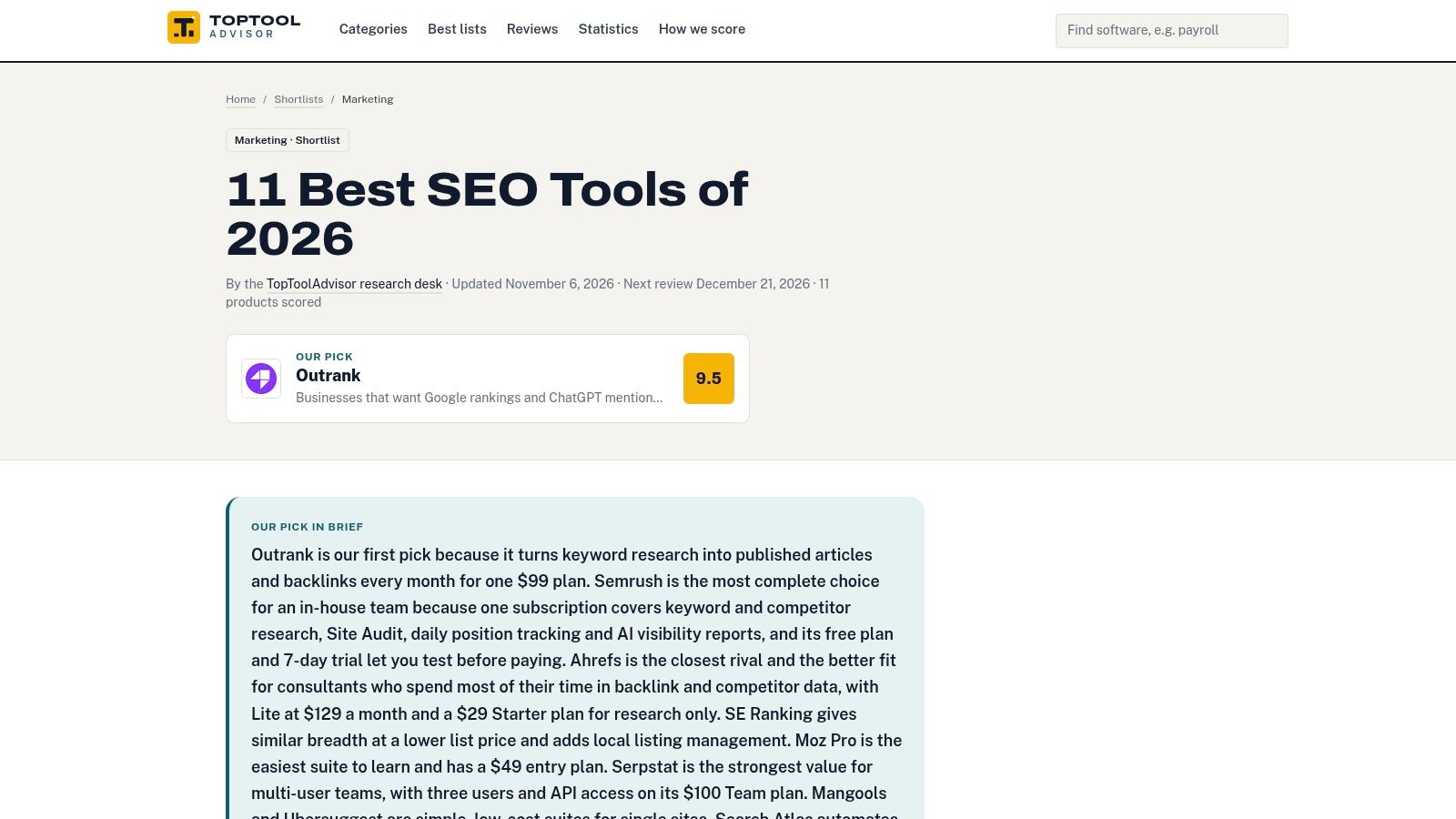
1. 11 Best SEO Tools of 2026
Start with the full field before buying any single platform. TopToolAdvisor's best SEO tools shortlist compares 8 to 10 products side by side, applies the same scoring method to each one and quotes every starting price word for word from the vendor's own pricing page with the date checked. Rankings are recomputed from fixed weights, so no vendor can buy a higher position, and the page states when it was last updated and next reviewed.
That layout suits buyers still deciding whether the main job is research, publishing, technical auditing or link work. Scores, prices, strengths and drawbacks sit next to each other, so a trade-off shows up in one glance rather than across a row of open tabs.
Why the Shortlist Comes First
Adoption differs sharply by company size. A survey summary reported by Digital World Institute states that 73% of small and midsize businesses use Google Search Console as their only regularly used SEO platform, while 84% of enterprise SEO teams use at least three premium tools daily. Small teams shouldn't copy an enterprise stack, and enterprise teams shouldn't expect one entry plan to cover a full team's workflows. The shortlist's real value is separation by operating maturity, budget and workflow depth.
- Best first move: Compare the full field, then trial the one tool matched to your dominant weekly job.
- Evidence check: TopToolAdvisor's SEO statistics collection links each figure to its original publisher, which separates market claims from product claims.
- Read past the total score: The method weights features 35%, ease of use 35% and value 30%. Buyers who care mainly about auditing should compare the per-criterion scores, and vendor pricing can change after the date checked.
A high score only helps when the first paid tier covers the work a team actually repeats each week.
The practical recommendation is direct. Use the ranking to shortlist two candidates, judge each on what its free plan and first paid tier include, and ignore top-tier features during the first comparison. Check project caps, keyword limits, export rules, API access and geographic coverage before price becomes the deciding factor. A cheaper plan that caps tracked keywords below a site's real footprint costs more in workarounds than the upgrade saves.
2. Semrush
Choose Semrush when one subscription must cover keyword research, competitor analysis, position tracking, backlink tools and site auditing. It's the broad option for small teams and agencies that don't want separate tools for each recurring workflow. Higher plans add historical data, content tools, more tracking capacity and Business API access, so growth should be planned through the tier ladder rather than assumed.
Pricing needs careful reading. Semrush's SEO Toolkit pricing page, checked in 2026, lists the entry SEO and AI Search plan at $117.33 per month when billed annually, followed by $165.17 per month and $248.17 per month when billed annually. It also lists SEO Classic Pro at $139 per month on monthly billing. Buyers shouldn't compare an annual-billing monthly equivalent against a rival's month-to-month rate.
What Earns the Subscription
- Breadth: Keyword, competitor, backlink, tracking and audit tools sit in one platform.
- Trial access: A seven-day free trial is available for the SEO toolkit.
- AI-search context: Volatility makes position data incomplete by itself.
AI coverage is uneven across queries. Semrush's 2025 AI Overviews study reported AI Overviews on 6.49% of tracked keywords in January, nearly 25% in July and 15.69% in November. Semrush fits teams that'll track that movement by market, device and intent. A very small site with occasional SEO work won't recover the cost as easily, and usage limits can force upgrades or add-ons as projects accumulate.
3. Ahrefs
Link analysis decides this pick. Ahrefs fits buyers whose central questions concern backlinks, competitor domains, organic keywords and content gaps, with site auditing included rather than treated as the sole purpose. Site Explorer anchors research into a domain's search and link profile, while paid plans add keyword research and rank tracking. The limited free account gives verified website owners a low-cost starting point for monitoring their own properties.
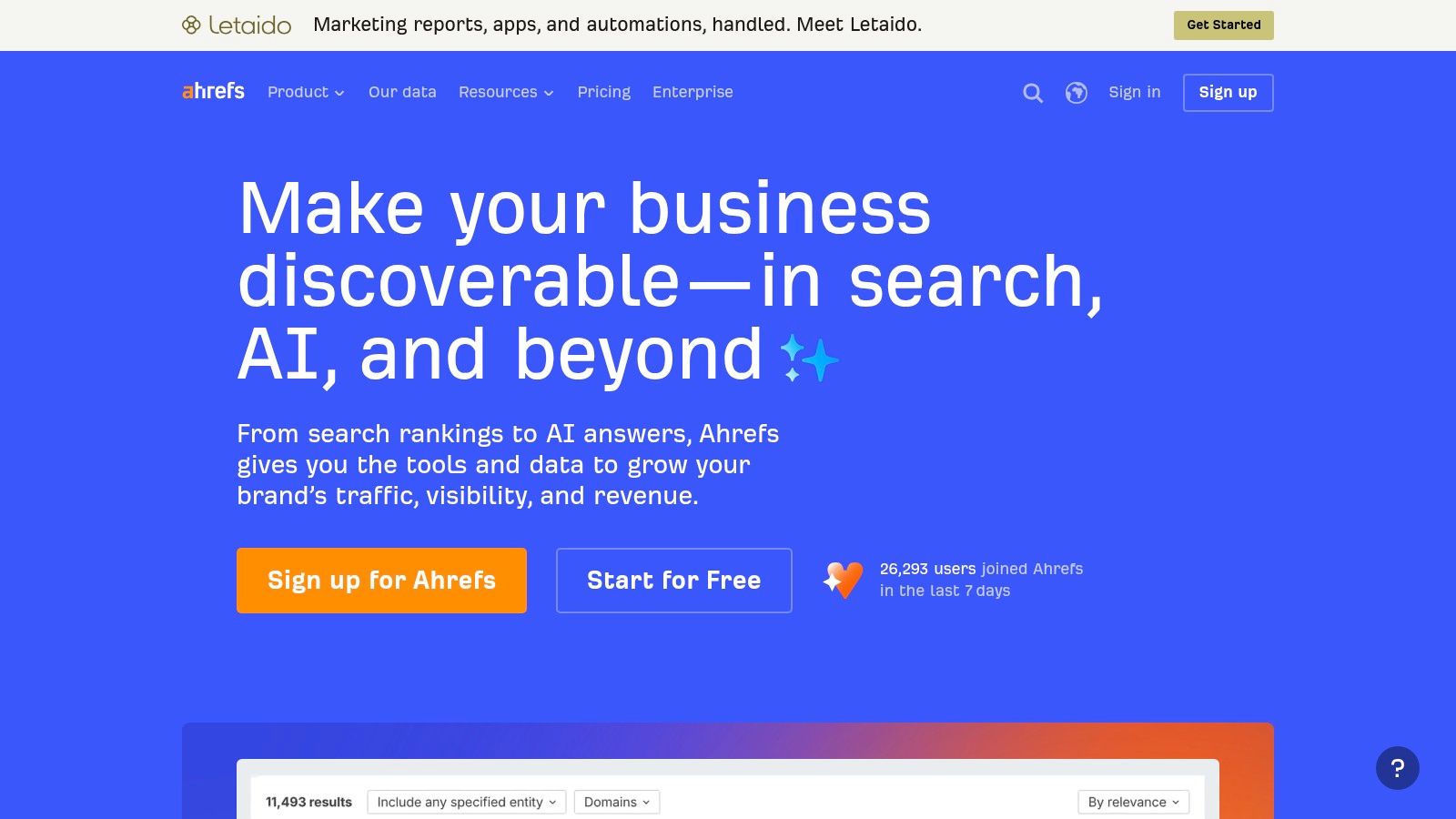
Seat maths matters more than the headline plan. Ahrefs' pricing page, checked in 2026, lists displayed monthly prices of $129, $249 and $449, and states that adding 10 more users costs $80 per month each. The entry paid tier in the plan comparison is Lite from $129 per month. Agencies should calculate the cost with every analyst included before comparing Ahrefs with a suite that bundles seats differently.
- Free-plan reality: Useful access exists for verified sites, but it doesn't provide unrestricted research on any domain.
- Strongest fit: Teams investigating competitor links, high-value pages and keyword overlap each week.
- Weakest fit: Solo operators who mainly need a crawler or occasional rank checks.
Ahrefs earns its price when link and competitor findings change publishing or outreach decisions. It doesn't earn its price as a passive dashboard.
4. Moz Pro
Moz Pro is the conventional toolkit choice for a small business that wants keyword research, rank tracking, site crawling and SEO issue monitoring without moving straight to a larger research suite. Its Standard plan is positioned for smaller teams and includes tracked sites, tracked keywords and a monthly crawl allowance. MozBar Premium adds browser-based inspection of on-page elements and search results, which suits quick page reviews during normal browsing.
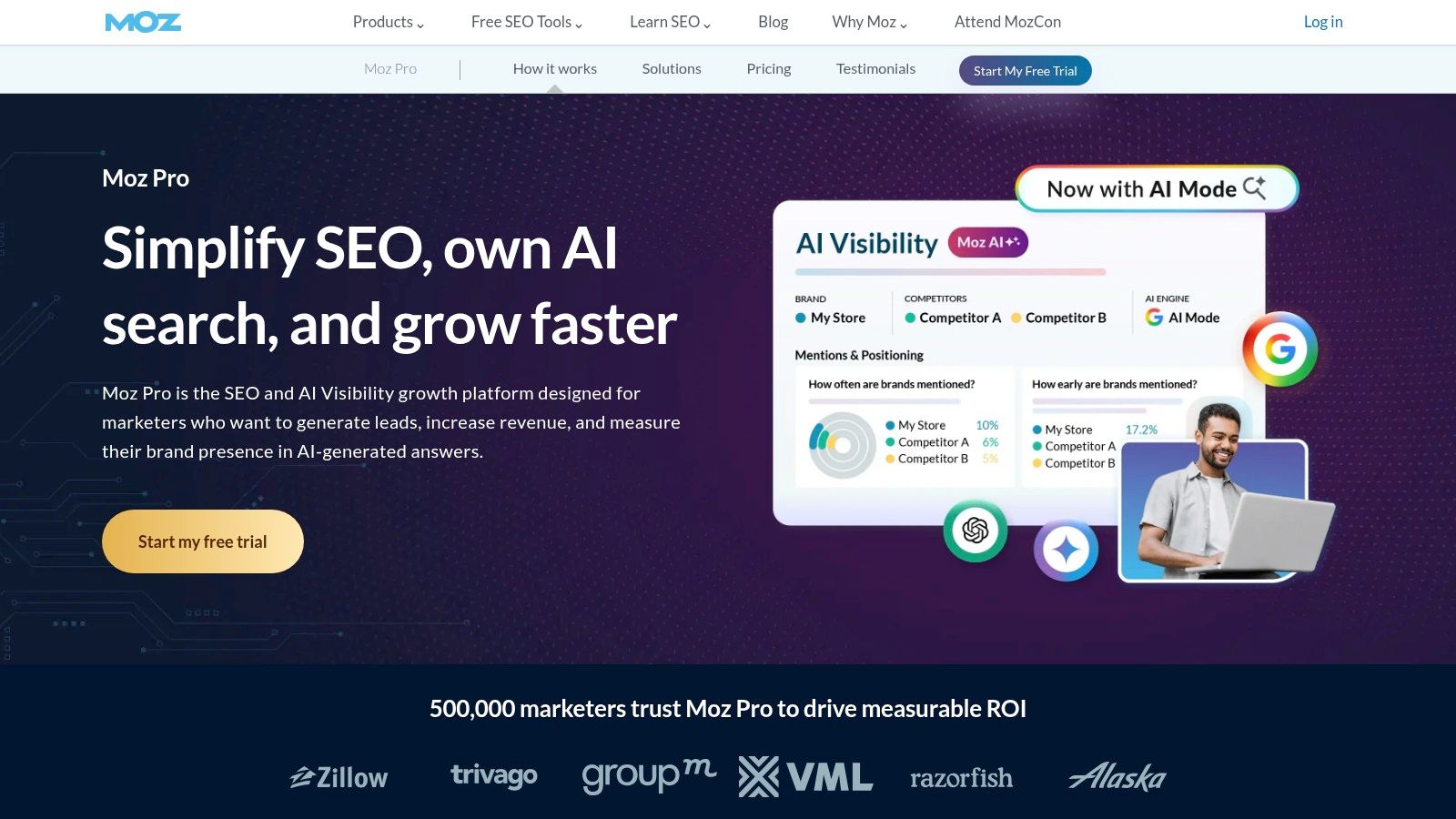
The Standard plan is listed at $99 per month, or $79 per month billed annually, on the Moz Pro product page. That lower annual equivalent only represents value if the included site, keyword and crawl allowances cover a full year of work. Agencies managing many properties should check those quotas before treating Standard as the cheaper route.
Where Moz Pro Works Best
Continuous monitoring matters because search doesn't stand still. Moz's history of Google algorithm changes reports that Google made approximately 35,000 changes to search across 2009 to 2023 and reported 4,781 search-related launches in 2023. Rank tracking, crawl alerts and historical comparisons are therefore core functions, not optional reporting extras.
Moz Pro suits a contained site portfolio with recurring keyword and technical checks. Buyers needing wider competitive research, larger crawl capacity or deeper link workflows should compare higher tiers or a specialist tool before committing annually.
5. SE Ranking
Buy SE Ranking when one subscription has to cover the full weekly SEO cycle. SE Ranking combines Rank Tracker, keyword research, competitive research, Website Audit, On-Page SEO Checker and Backlink Checker in a single platform, so a small team can check positions, find terms, review rivals and fix page issues without paying for a separate product at each step.
Core is listed at $129 per month, or $103.20 per month billed annually, on SE Ranking's pricing page. The same page advertises a 14-day trial with no credit card required, which makes SE Ranking one of the cleaner first tests in this list. There is no permanent free plan, and agency or API capabilities may require paid add-ons, so spend the trial on reporting and data export tasks rather than only keyword lookups.
SEO teams rarely run a single product for every task. The Advanced Web Ranking 2017 SEO survey found that 55% of marketers use two to four tools for keyword research and 53% use two to four for link analysis. SE Ranking works well as the central platform in that kind of stack, particularly for location-aware reporting. Businesses buying mainly for that use case should compare it against TopToolAdvisor's local SEO tools shortlist before assuming general rank tracking covers local requirements.
6. Screaming Frog SEO Spider
Buy a crawler when the problem is technical. Screaming Frog SEO Spider is a desktop tool for finding broken links, errors, redirects, title and meta issues, robots directives and hreflang problems. It also generates XML sitemaps and inspects structured data. Paid functions add JavaScript rendering, crawl comparison, saved crawls and integrations with Google Analytics, Search Console and PageSpeed Insights.
The free version crawls up to 500 URLs per crawl, and a paid licence is listed at £199 per user per year, according to the Screaming Frog SEO Spider page. Per-user pricing stays manageable for one technical specialist. It becomes a different calculation when several staff members need simultaneous licences across Windows, macOS or Linux machines.
Pair It With First-Party Data
Search Console should remain in place beside any crawler. Google Search Console Help states that the Performance report defaults to the previous three months and tracks clicks, impressions and average position, filterable by page, country, device and query. Average position means the property's topmost result, so it shouldn't be mistaken for the average rank of every owned result.
Practical rule: Use Screaming Frog to find technical faults, then use Search Console to confirm whether real queries, pages and devices are affected.
Screaming Frog isn't a substitute for keyword discovery or competitor backlink research. It's the specialist purchase for site migrations, template faults, redirect chains, indexation checks and repeatable technical audits.
7. SpyFu
Competitor curiosity has a cheaper entry point. SpyFu focuses on the keywords and ads associated with domains, then adds competitor comparisons, keyword groups, SEO rank tracking, reports and historical data on paid plans. It suits marketers investigating how rivals win search visibility more than teams looking for a broad technical platform.
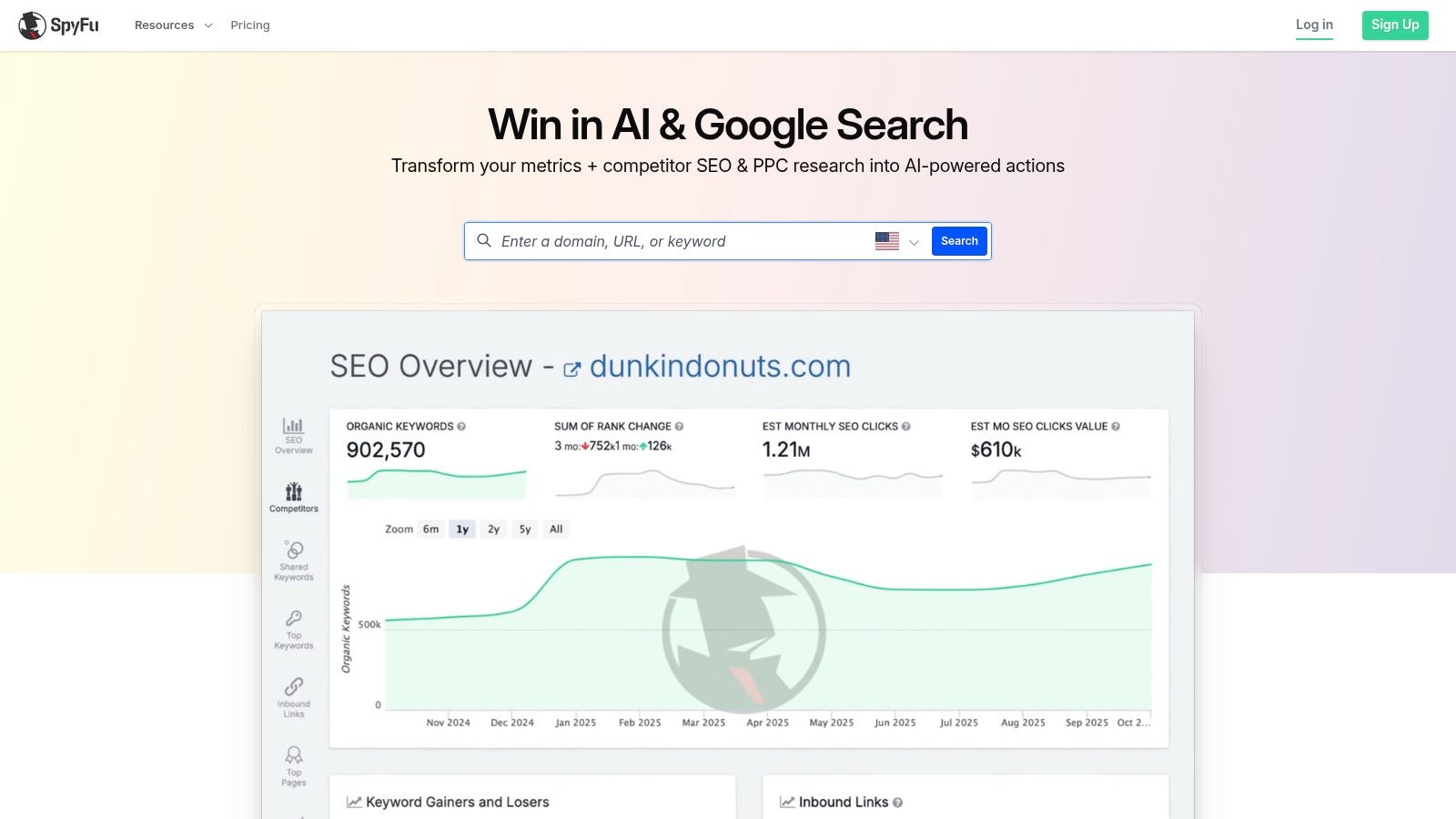
Basic is listed at $39 per month, or $33 per month billed annually, on SpyFu's website. Limited free access allows initial exploration without a subscription. Paid plans advertise unlimited searches, but Basic keeps result and export caps that don't apply to Professional, so search volume alone shouldn't drive the tier choice. Export needs should be tested early.
The wider market explains SpyFu's Google-centred competitor view. SearchEngines.net's search engine market share history reports that Google accounted for 89.2% of U.S. general-search queries in 2020, up from approximately 80% in 2009. Google visibility therefore remains the main competitive battlefield for most U.S. buyers, even though regional and device coverage still need checking.
Teams whose next step is deeper term selection should compare SpyFu against TopToolAdvisor's keyword research tools shortlist. Technical crawling will still require another product, so SpyFu works best as a focused competitor layer rather than the only paid SEO platform.
The 7 SEO tools compared
| Tool | Starting price (as published) | Free plan or trial | Best for |
|---|---|---|---|
| 11 Best SEO Tools of 2026 | Not applicable; comparison guide | Not applicable | Comparing 11 SEO tools by score, price, strengths, and drawbacks |
| Semrush | $139/month; $117.33/month billed annually | 7-day free trial | Teams seeking a broad SEO and marketing suite |
| Ahrefs | $129/month | Limited free account; some features require site verification | Backlink, keyword, and competitor research |
| Moz Pro | $99/month; $79/month billed annually | Not specified | Core SEO research, rank tracking, and site monitoring |
| SE Ranking | $129/month; $103.20/month billed annually | 14-day trial; no credit card required | Small teams managing recurring SEO workflows |
| Screaming Frog SEO Spider | £199 per user per year | Free version crawls up to 500 URLs per crawl | Technical website crawling and SEO issue detection |
| SpyFu | $39/month; $33/month billed annually | Limited free access | Competitor keyword and advertising research |
How to Choose Your SEO Tool and Verify the Price
Match the purchase to the dominant job first. Choose Semrush or SE Ranking for an all-in-one workflow, Ahrefs when link and competitor research drives decisions, Screaming Frog for technical crawling, Moz Pro for a contained monitoring setup, and SpyFu for competitor keyword investigation. The full shortlist should settle the category before plan pages settle the tier.
Check the first paid tier, not the largest plan. Record included projects, tracked keywords, crawl allowances, seats, exports, locations, historical data and API access in the same order for every candidate. Then verify whether the displayed price requires annual billing. A lower monthly equivalent isn't cheaper if another seat, location or reporting add-on pushes the account into a higher tier within the first quarter.
Structured-data work also needs effort counted separately from licence cost. Google Search Central's structured data guidance sets out a workflow of adding required properties, validating with the Rich Results Test, deploying markup, inspecting URLs, requesting recrawling when needed and submitting a sitemap. A platform can flag schema issues, but CMS or developer time still determines how quickly fixes reach Google.
TopToolAdvisor's research desk compares 8 to 10 products per shortlist, scores every product on the same features, ease of use and value weights, and quotes each price exactly as the vendor publishes it with the date checked. The site has no affiliate deals, owns no part of any vendor and sells no placement in its rankings, so order comes only from the published scoring method. Its shortlists draw on profiles for 368 software products, giving buyers a wider base than the final ranked list alone.
Start with one no-card or free-trial option from this list, run a real keyword set, one site audit and one export, then compare the result against the first paid tier before accepting annual billing.
Questions or corrections: editorial@toptooladvisor.com